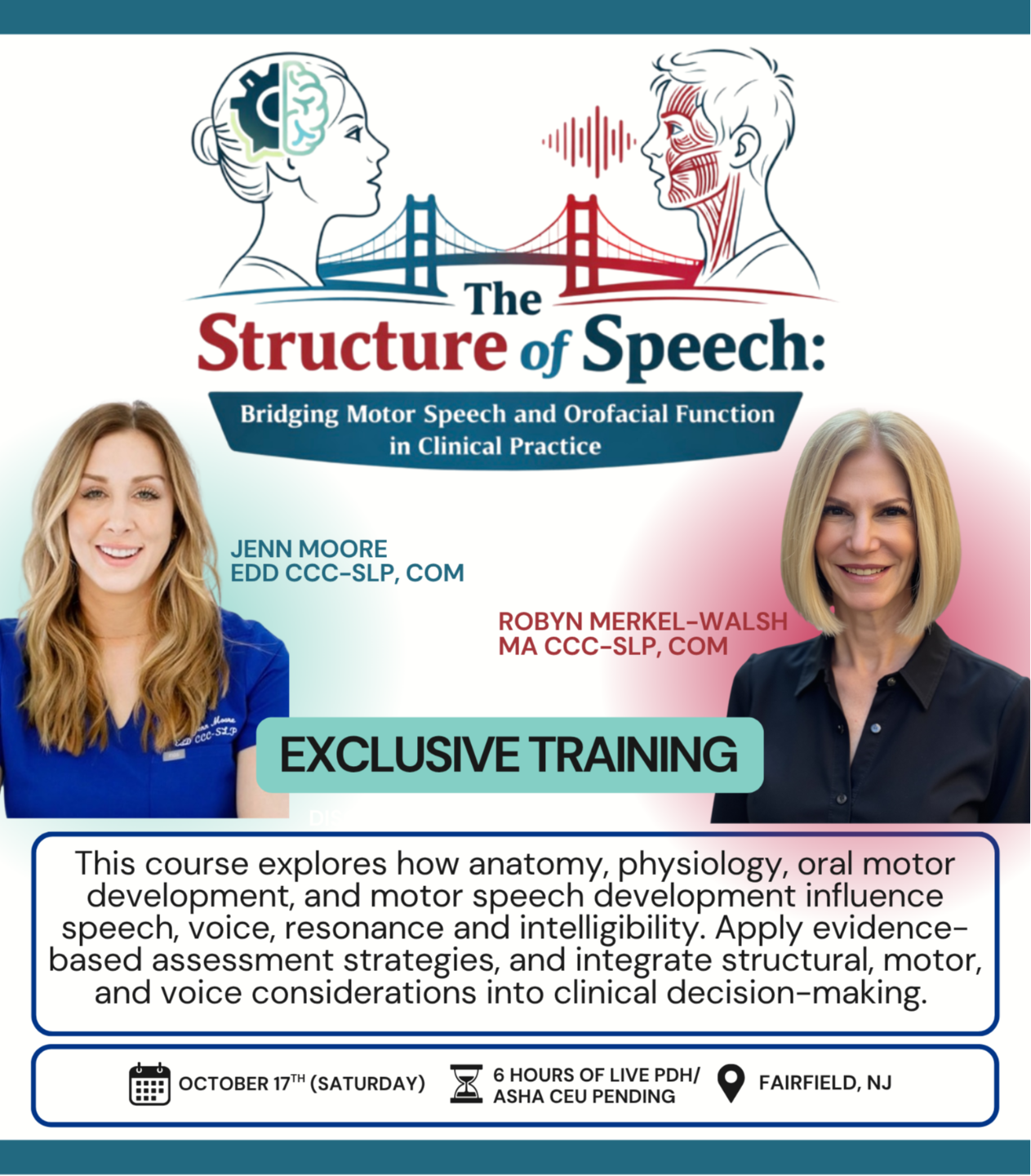
LIVE IN PERSON
Date: Saturday, October 17th, 2026
Time: 8:30-4:00 (1 hour lunch)
Location: In person
Best Western Fairfield
216 Route 46 West
Fairfield, NJ 07004
Instructional Level: Advanced Level
Target Audience: Licensed SLPs with at least 2 years of experience
ASHA CEUs: 0.6
*Pending ASHA CEUs approval
Cost: $247 USD
Short Course Description
Speech sound disorders are often viewed through phonological, articulation or motor speech frameworks alone; however, structural and physiological factors can significantly influence voice, resonance, and speech intelligibility. This course explores the relationship between anatomy, physiology, oral motor development, motor speech development, and voice production as they relate to speech assessment and intervention.
Participants will examine structural components that contribute to speech production, including craniofacial and orofacial myofunctional anomalies, and learn strategies for documenting clinical findings pertaining to both educational and medical settings. The course reviews typical oral motor and motor speech developmental milestones and discusses how atypical development may affect communication outcomes. Using the Power–Source–Filter framework often applied to voice, attendees will explore the interaction between respiration, phonation, articulation, and resonance, and how disruptions within these systems can contribute to distortion patterns and reduced speech clarity.
Current research examining structural contributions to speech production will be reviewed, including areas of consensus and ongoing debate within the literature. Through an evidence-based practice lens, participants will learn to integrate structural, motor, and voice considerations into comprehensive assessment and treatment planning. This course is designed for speech-language pathologists seeking a broader understanding of the factors that influence speech production and a practical framework for clinical decision-making.
Full Course Description
Speech sound disorders have traditionally been viewed through phonological, articulation, or motor speech frameworks. While these models provide valuable clinical guidance, they may not fully account for the complex interaction among structure, motor control, phonation and resonance that contribute to speech intelligibility. As research continues to evolve, speech-language pathologists are increasingly challenged to integrate information from multiple domains to develop comprehensive assessment and intervention plans. This course examines the intersection of speech production, anatomy, physiology, motor development, and orofacial myology to provide clinicians with a broader framework for understanding speech sound disorders across the lifespan.
Drawing from more than two decades of collaboration, Robyn Merkel-Walsh, MA, CCC-SLP, COM®, and Jennifer Moore, EdD, CCC-SLP, COM®, bring together extensive expertise in motor speech disorders, oral motor and feeding development, orofacial myology and clinical education. Their combined experiences as clinicians, authors, researchers, and adjunct professors have shaped a course designed to bridge the gap between foundational speech science and contemporary clinical practice. Through years of teaching graduate students and mentoring clinicians, they have identified recurring areas of confusion regarding the role of structure and function in speech production and developed practical frameworks to help clinicians navigate these complex relationships.
Participants will explore the anatomical and physiological foundations of speech production, including the contributions of respiration, phonation, articulation, and resonance. The course will review craniofacial and orofacial myofunctional differences that may influence speech clarity and discuss strategies for documenting structural findings in both educational and medical settings. Typical oral motor and motor speech developmental milestones will be examined, along with indicators of atypical development that may affect overall communicative function.
A central component of the course is the application of the Power–Source–Filter framework as a means of understanding how respiratory support, voice production, resonance, and articulatory precision work together to support intelligible speech. Participants will learn to recognize how disruptions within these systems may contribute to distortion patterns, reduced intelligibility, compensatory behaviors, and diagnostic uncertainty. The course will also examine current evidence regarding structural influences on speech production, including areas of consensus, controversy, and emerging research.
To support a modern understanding of speech assessment and treatment, participants will be introduced to technologies increasingly used in both research and clinical practice. These include spectrographic analysis, acoustic measures, ultrasound imaging, and visual biofeedback tools that allow clinicians to observe and measure aspects of speech production that were previously difficult to visualize. Discussion will focus on how these technologies are expanding our understanding of speech motor control, articulation, resonance, and treatment outcomes while informing evidence-based clinical decision-making.
Designed for speech-language pathologists who want to remain on the cutting edge of clinical practice, this course challenges participants to think beyond traditional diagnostic silos and embrace a more integrated view of communication. By combining insights from motor speech, voice, feeding, anatomy, physiology, and orofacial myology, attendees will gain practical tools and contemporary perspectives that can be immediately applied to assessment, differential diagnosis, treatment planning, and interdisciplinary collaboration. Participants will leave with a deeper understanding of the evolving science of speech production and a framework for addressing the complex factors that influence speech clarity and communicative success.
Learning Outcomes
- Participants will list three structural anomalies that may impact speech clarity.
- Participants will identify three distinguishing characteristics of motor planning, motor execution, and structural speech disorders.
- Participants will describe two applications of ultrasound imaging for the assessment and treatment of speech sound disorders.
Agenda
8:15 - 8:30 -> Registration
8:30–8:45 -> Disclosures
• Financial disclosures
• Non-financial disclosures
• Collaboration framework
8:45–9:15 -> Introduction
• Course overview and clinical rationale
• Defining gaps in traditional speech sound disorder models
• Integrating structure, motor speech, and voice frameworks
9:15–10:15 -> Anatomy and Physiology for Speech Production
• Structural components influencing articulation and resonance
• Functional integration of respiration, phonation, and articulation
• Relationship between anatomy, physiology, and speech intelligibility
10:15 - 10:30 -> Break
10:30–11:15 -> Documentation of Structural Findings
• Identification of craniofacial and oral structural differences
• Documentation strategies for clinical and educational settings
• Connecting structural findings to speech characteristics
• Visualization methods (ultrasound, CBCT, ankyloglossia assessments)
11:15–12:00 -> The Power–Source–Filter Framework
• Respiratory (power), phonatory (source), and articulatory/resonance (filter) systems
• Interaction of voice and articulation in speech production
• Clinical implications for distortion patterns and reduced intelligibility
12:00–1:00 -> Lunch
1:00–1:45 -> Motor Development and Norms
• Typical orofacial development across childhood
• Relationships among feeding, swallowing, and speech
• Indicators of atypical oral motor development
1:45–2:30 -> Motor Speech Development and Norms
• Development of motor planning and motor execution skills
• Differentiating phonological, motor planning, and motor execution disorders
• Clinical parameters for assessment and intervention
2:30–2:45 -> Break
2:45–3:30 -> Evidence Base: Structural Contributions to Speech
• Current research examining structural influences on speech production
• Interpretation of mixed and emerging evidence
• Application within an evidence-based practice framework
3:30–3:50 -> Conclusion
• Key clinical takeaways
• Integrating structural, motor, and voice considerations into practice
3:50–4:00 -> Q&A
• Questions and discussion
Certificate of Completion Requirements
To receive the certificate of completion and/or ASHA CEUs (pending ASHA CEUs approval), participants must meet the following criteria:
- Attend the full duration of the course (attendance will be tracked automatically).
- Complete a test based on the learning outcomes and receive a score of >80%.
- Complete a post-course program evaluation survey.
Deadline: Complete the test and post-evaluation survey by Saturday, October 24th, 2026 - 11:59 PM EST!
Meet Your Speakers
Jennifer Moore, EdD, CCC-SLP, COM®
Jennifer Moore is a speech-language pathologist, adjunct professor, author, entrepreneur, and international speaker with expertise in motor speech disorders, speech sound disorders, pediatric feeding, and orofacial myology. She is the owner of Moore Motor Speech and Brave Wings Therapy, where she provides specialized services for children with complex communication needs. Dr. Moore is widely recognized for her work in the assessment and treatment of childhood motor speech disorders and for her ability to translate research into practical clinical applications. Through her teaching, writing, and presentations, she has educated and mentored clinicians worldwide while advancing evidence-informed practice and interdisciplinary collaboration in motor speech and orofacial myofunctional disorders.
Robyn Merkel-Walsh, MA, CCC-SLP, COM®
Robyn Merkel-Walsh is a speech-language pathologist, vocologist, adjunct professor, and owner of Diamond MYO & Vocology in Ridgefield, New Jersey. With over 30 years of clinical experience, she specializes in orofacial myofunctional disorders, pediatric feeding and swallowing, motor speech disorders, voice, and tethered oral tissues. Robyn is a clinical instructor for TalkTools®, Board Chair of the Oral Motor Institute, and is an Ambassador/Guest Faculty for The Breathe Institute. An international speaker, author, and recipient of multiple ASHA ACE Awards, she is passionate about advancing evidence-informed practice through education, interdisciplinary collaboration, and clinical mentorship.