
Neurodiversity-Affirming Motor Speech Therapy for Autism and Childhood Apraxia of Speech
Mar 12, 2026
Parents and clinicians often ask an important question:
Why is my autistic child struggling so much with speech?
For some children, the challenge is not just language development. It may involve motor planning for speech, such as Childhood Apraxia of Speech (CAS).
Our published tutorial article introduces a framework designed specifically for this population. We highlight how these two profiles can overlap and how therapy should evolve to integrate both motor speech intervention and neurodiversity-affirming care.
Read the full article here:
When Autism and Childhood Apraxia of Speech Overlap
Autism and speech sound disorders frequently co-occur, but the reasons for limited speech are not always the same.
Some autistic children experience:
- inconsistent speech production
- difficulty sequencing sounds
- limited phonetic inventory
- reduced intelligibility
- effortful speech attempts
These characteristics may reflect motor speech differences, including Childhood Apraxia of Speech.
Research suggests that speech motor ability can influence language development, meaning that children with speech motor challenges may need therapy that directly supports movement for speech, not just vocabulary or language comprehension.
This is where motor-based speech intervention becomes important.
What Is Neurodiversity-Affirming Therapy?
Neurodiversity-affirming practice recognizes that neurological differences are natural variations in human development.
The goal of therapy is not to change who a child is, but to support communication, participation, and autonomy.
For speech therapy, this means:
- respecting bodily autonomy
- supporting sensory regulation
- honoring all forms of communication (AAC, gestures, speech)
- building on strengths and interests
- avoiding compliance-based therapy models
Motor speech therapy can still be effective within this framework—it simply requires thoughtful adaptation.
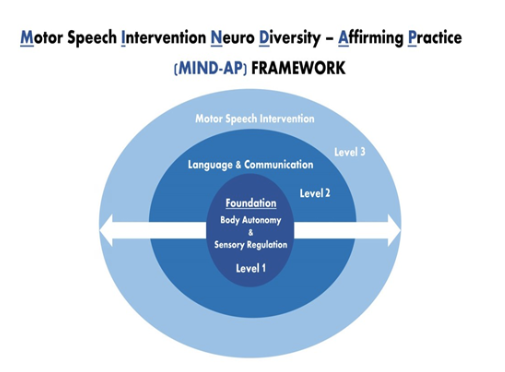
The MIND-AP Framework
The article introduces the MIND-AP Framework (Motor Speech Intervention for Neurodiversity-Affirming Practices).
This framework integrates motor speech science with neurodiversity-affirming principles.
It includes three key levels.
Level 1: Regulation and Bodily Autonomy
Motor learning cannot occur when the nervous system is overwhelmed.
Therapy should begin with supporting regulation and safety.
This includes:
- respecting a child’s right to accept or decline touch (tactile cues)
- offering sensory supports
- allowing extra processing time
- recognizing non-verbal communication cues
- adjusting expectations during dysregulation
When children feel safe and regulated, they are better able to engage in learning.
Level 2: Communication First
Speech is only one form of communication.
This level focuses on building meaningful communication through:
- AAC supports
- gestures and scripts
- shared interests
- functional vocabulary
- play-based interactions
Speech goals should always support real communication opportunities, not just isolated drill practice.
Level 3: Motor Speech Intervention
Once regulation and communication supports are established, clinicians can target speech movement patterns.
Motor-based approaches such as Dynamic Temporal and Tactile Cueing (DTTC) and PROMPT therapy can be incorporated within a neurodiversity-affirming model.
Adaptations may include:
- shorter practice bursts
- sensory-friendly cueing
- interest-based practice activities
- visual supports instead of face-watching
- flexible pacing
The goal is to support speech development while respecting the child’s sensory and learning profile.
Why This Matters for Parents
Parents sometimes hear conflicting advice:
Some professionals suggest focusing only on language or AAC, while others recommend intensive speech therapy.
The reality is that both communication and speech development can be supported together.
If a child has motor speech challenges, targeted therapy may help them:
- expand their sound inventory
- produce clearer speech
- increase communication independence
At the same time, therapy should respect autonomy, regulation, and neurodiversity.
Why This Matters for SLPs
This research highlights an important clinical takeaway:
Limited speech in autistic children should not automatically be assumed to be purely language-based.
SLPs should consider:
- speech motor assessment
- phonetic inventory analysis
- speech movement variability
- motor planning markers
Integrating motor speech frameworks with neurodiversity-affirming care may lead to more individualized and effective therapy plans.
The Future of Motor Speech Therapy
The field of speech-language pathology is moving toward a more integrated model of care.
Rather than separating motor speech therapy and neurodiversity-affirming practice, clinicians can combine both approaches to better support autistic individuals with co-occurring speech motor challenges.
As research evolves, this integrated perspective may help improve diagnostic clarity, therapy outcomes, and family support.
Reference
Moore J., Boyle J., & Namasivayam A. Neurodiversity-Affirming Motor Speech Intervention for Autistic Individuals with Co-Existing Childhood Apraxia of Speech: A Tutorial.
Read the full article here:
Ready to boost your motor speech confidence?
Join The Next Level Motor Speech Membership and be the first to access monthly tools, expert guidance, and a community that gets it.
